Showing posts with label JAPAN. Show all posts

Thursday, February 10, 2011

Alpha Resort Tomamus Ice Hotel

   Japan-ice-hotel-04       

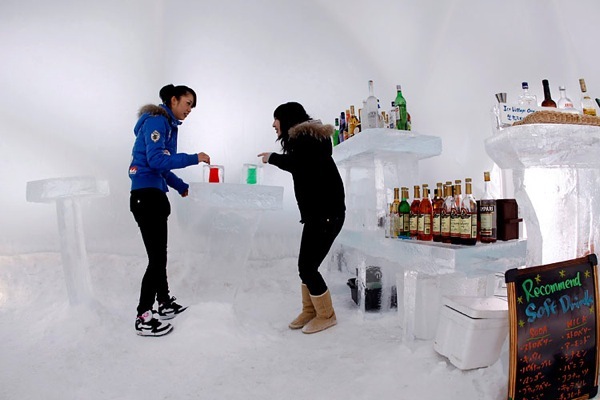
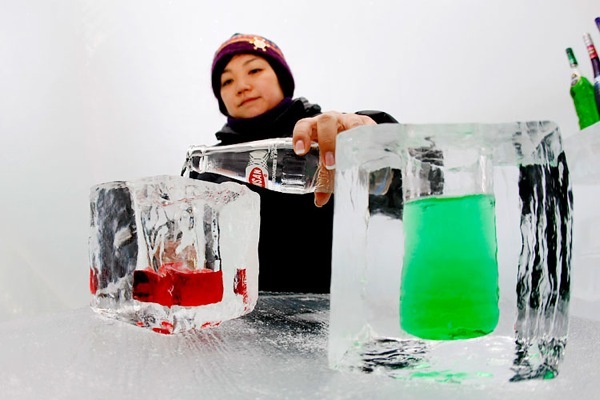
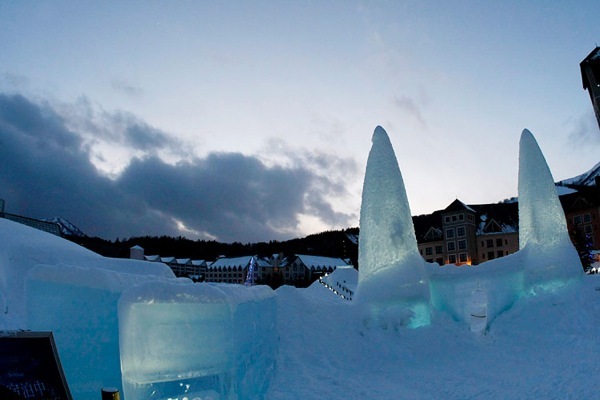
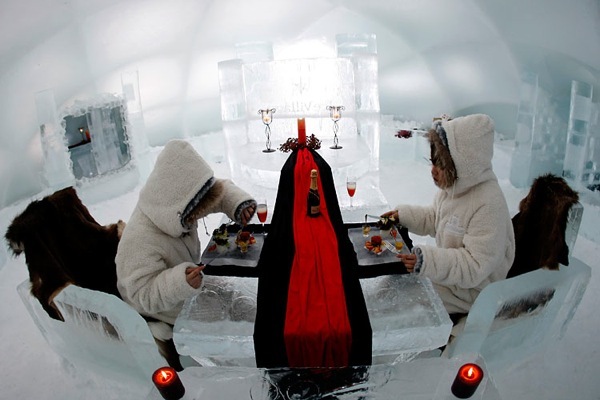
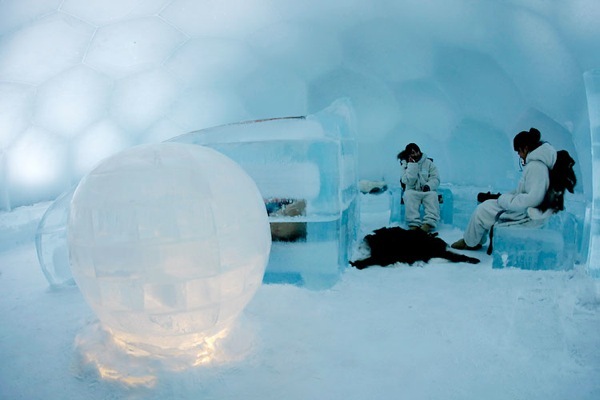
On the island of Hokkaido, in the ski resort opened a unique volumes ice hotel, which is part of a complex of ice with a bar and an ice chapel.

Japan-ice-hotel-10

Japan-ice-hotel-06

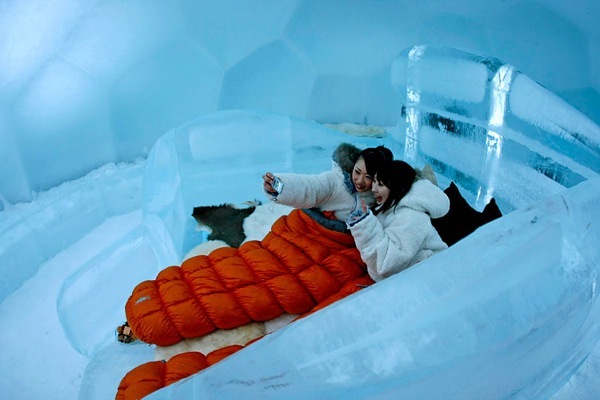
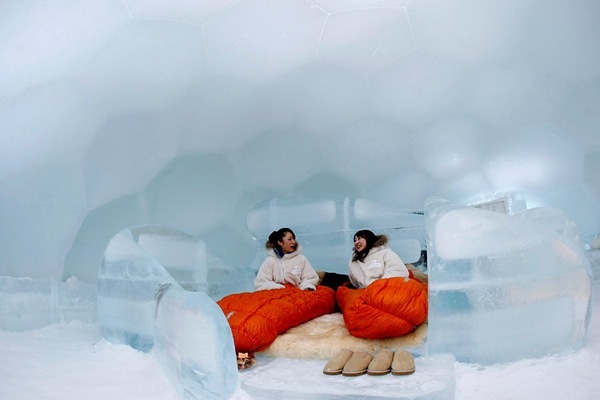
Built from the ice hotel Alpha Resort Tomamus Ice Hotel includes only one double room, located under the ice dome.

 Japan-ice-hotel-07

Japan-ice-hotel-03

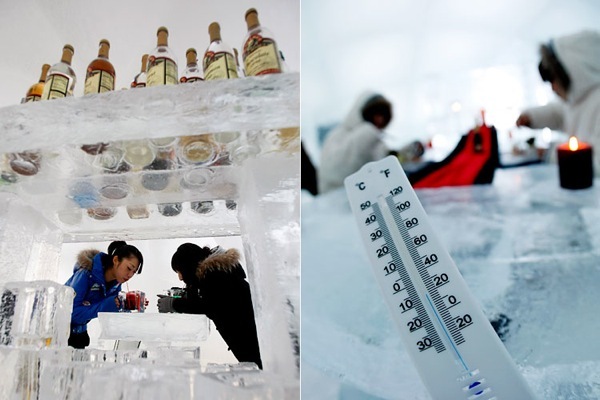
To spend the night stands to stock up considerable frost - tables, chairs and even a bed in the room is made of blocks of ice, and the temperature can drop to -25 º C. Japan-ice-hotel-08

For visitors of Ice Hotel recommended to "hibernate" in a thick sleeping bags.

Japan-ice-hotel-02

Japan-ice-hotel-11

Japan-ice-hotel-09

To emphasize the unusual beauty of the cold edge of the resort volumes, Japanese engineers and scientists  was developing the idea of an ice hotel, where all thought out in every detail over 9 years. Japan-ice-hotel-05

Japan-ice-hotel-01

Employees of the Ice Hotel are very concerned about the hotel, the thickness of the wall which is 15 cm, they are constantly spray snow on the icy wall of the hotel, so that direct sunlight does not hurt them.

The hotel will remain open until February 15.

Photo: Kim Kyung-Hoon / Reuters

Wednesday, February 9, 2011

Sento Imperial Palace Garden's Feature Islands

Sentō Imperial Palace Stroll garden designed by Kobori Enshu. Addr.: Kyoto Gyoen-nai, Kamigyo-ku, Kyoto, (in the Kyoto Old Imperial Palace compound). Near Marutamachi Subway Sta. Guided tours (in Japanese) are available. The garden's primary feature is a large pond with islands and walkways, whose north and south segments were linked by a short canal in 1747. The north pond was extended and reworked from 1684-1688; the south pond is notable for its expansive "ocean shore" of rounded stones and cherry trees, an edging of mixed natural and hewn stones, and a separate, understated embankment of squared stones. The ponds contain a variety of highly picturesque islands and six bridges in a varied styles, including one with an impressive wisteria trellis (built 1895).

Sento Imperial Palace was completed in 1630 for Emperor Go-Mizunoo's retirement, along with the corresponding Ōmiya Palace for the Empress Dowager Nyoin. Both palaces were repeatedly destroyed by fire and reconstructed until a blaze in 1854, after which the Sento palace was never rebuilt. (Ōmiya Palace was, however, reconstructed in 1867 and is still used by the emperor whenever he visits Kyoto). Today only two Sento structures, the Seika-tei and Yushin-tei teahouses, remain. The excellent gardens, laid out in 1630 by renowned artist Kobori Masakazu (Kobori Enshu), are now its main attractions.


Shugakuin Imperial Villa Public Through Guided

The Shugakuin is only accessible to the public through guided tour must be booked in advance and lasts about one hour and twenty minutes. It takes visitors through all three villas, and points out the significant garden features and structures. The tour is only offered in Japanese, however, an English audio guide is available.
The Shugaku-in was originally constructed by the retired Emperor Go-Mizunoo, starting in 1655, with the initial construction completed in 1659. The site had been previously occupied by the Enshō-ji nunnery, founded by his oldest daughter, Princess Ume-no-miya; it was moved to Nara to make room for Go-Mizunoo's creation.

The Upper Garden contained a large artificial pond, created by building an earthen dam across a ravine; the pond contains a number of small islands. Unlike the typical Japanese garden, it is a very large stroll garden, making extensive use of the technique of "borrowed scenery". The Lower Garden was originally much more informal than what is now there; originally it was more of a simple arrival station for visiting guests.


After Go-Mizunoo's death, his daughter Princess Mitsuko became a nun, and established another temple there, the Ryinku-ji, in what later became the Middle Garden. The gardens and buildings then fell into disrepair, with some of the buildings either being destroyed, or removed. During the rule of Tokugawa Ienari, the 11th Tokugawa shogun, the Shūgaku-in was thoroughly renovated.


Shugakuin Imperial Villa Stroll garden laid out in the 17th. This garden is characterized by a complete
unification of nature and garden. Addr.: Shugakuin, Sakyo-ku, Kyoto. 15min. walk from Shugakuin-Rikyu-michi Bus Stop or Shugakuin Sta. on Eizan Dentetsu Line. Guided tours (in Japanese) are available.

Katsura Imperial Villa Beautiful Garden Of Japan

Katsura Imperial Villa A typical stroll garden laid out in the 17th century. This garden is renowned as an
outstanding example of Japanese landscape gardening. Addr.: Misono, Katsura Saikyo-ku, Kyoto. 20-min. walk from Katsura Sta. on Hankyu Dentetsu Line; or reached from Katsura-Rikyu-mae Bus Stop. Guided tours (in Japanese) are available. Free tours of Katsura Imperial Villa are held several times daily in Japanese only. No tours are held on Sundays and national holidays. Most Saturdays are also unavailable. Check with the agency for an up to date schedule.  The Katsura district of Kyoto has long been favored for villas, and in the Heian period, Fujiwara no Michinaga had a villa there.


The members of the Heian court found it an elegant location for viewing the moon. Prince Hachijō Toshihito (1579–1629), the first of the Hachijō-no-miya line, established the villa at Katsura. The prince was a descendant of Emperor Ogimachi, and younger brother of Emperor Go-Yozei. Once adopted by Toyotomi Hideyoshi, he cancelled the adoption when Hideyoshi had a son, and founded the Hachijō-no-miya house. The Hachijō-no-miya house changed its name to Tokiwai-no-miya, Kyōgoku-no-miya, and finally Katsura-no-miya, before the line died out in 1881. The Imperial Household Ministry took control of the Katsura Detached Palace in 1883, and since World War II, the Imperial Household Agency has been in control.

 The shoin of Katsura Imperial Villa is divided into three parts: the Old Shoin, the Middle Shoin, and the New Palace. The Old Shoin was built in around 1615 A.D. The construction of the shoin, teahouse and garden continued in the time of the second prince, Toshitada (1619–1662), and reached completion after some decades.

Saturday, February 5, 2011

Byodoin Temple and Chishakuin Temple Tourism Temple In Kyoto Japan

Byodoin Temple 

Byodoin Temple Originally a pond garden for boating laid out in the 11th century. The construction of the temple and its garden was intended to recreate the Buddhist paradise in this world. Addr.: 116, Renge, Uji, Kyoto. 40 min. by train from Keihan-Sanjo to Uji on Keihan-Uji Line, or 30 min. by train from Kyoto Sta. to Uji Sta. on JR Nara Line.

The beautiful grounds include a two-acre reflecting lake, peacocks, swans, ducks, meditation niches, and little waterfalls. The mountains in the background and the lush gardens complete the scene.


Chishakuin TempleChishakuin Temple Is beautiful Landscape garden for viewing from within a building, designed by Sen-no-Rikyu (1522-1591), the great ceremonial tea master of the Momoyama Period. The garden retains a vestige of its former glory. Addr.: Higashiyama Shichijo, Higashiyama-ku, Kyoto. Near Higashiyama Shichijo Bus Stop.

Historical appeal of Kyoto City Trip To Japan Guide

Kyoto is an ancient city with a 1200 year history. It was established as Japan's capital under the name "Heian-kyo" in the year 794. Since then, Kyoto has preserved the beloved properties of its culture as testimonials of time. This is shown in a lot of ancient temples (e.g. Kiyomizudera, Kinkakuji) and shrines (e.g. Heian-jingu) built in styles unique to Kyoto. These properties as well as many festivals, ceremonies and traditional industries, attract people all over the world today. Kyoto is often called "Japan's heartland", and it is said that it is impossible to know the real Japan without knowing Kyoto.


Transportation
Kyoto's has an inadequately developed public transportation system, consisting of two subway lines (Karasuma line and Touzai line), a dense bus network and as many as half a dozen railway companies. Those railways (except subways) and buses, however, are almost irrelevant to tourists, although not completely. Taxis can be a worthwhile alternative.

City center
Kyoto's city center with the highest concentration of dining, shopping and entertainment opportunities, is located around the junction of Shijo-dori (4th Avenue) and Kawaramachi-dori (Kawaramachi Street). JR Kyoto Station is located south of the city center at the height of Hachijo-dori (8th Avenue). The most prominent north-south street is Karasuma-dori (Karasuma Street), which runs from Kyoto Station via the city center to Kyoto Imperial Palace.

Traditional nightlife
Gion is Kyoto's most famous geisha district. Stroll along Hanami-koji, a street lined by beautiful old buildings, teahouses and restaurants and you may be able to spot a geisha apprentice in the evening. Pontocho is another traditional nightlife districts. It is a narrow street running from Shijo-dori to Sanjo-dori, one block west of the Kamo River. In the evenings, the narrow street offers a great atmosphere and lots of restaurants and teahouses, ranging from inexpensive yakitori stores to highly exclusive establishments which require the right connections and expenses.

Kyoto has a rich history which has made it the cultural center of Japan. There is no way to experience all the city has to offer in our short stay, however, there are some general things that you should consider doing.

Temples and Shrines: Kyoto has about 1600 Buddhist temples and 400 Shinto Shrines. Seventeen have been declared UNESCO World Heritage Sites, including Nanzen-ji temple. It is known as one of Kyoto’s most pleasant temples with expansive grounds and many subtemples. It was built in 1291 and is the headquarters of the Nanzenji sub-sect of the Rinzai sect of Buddhism.

Experiencing Traditional Culture: Kyoto has many tourist attractions that will allow you to experience the traditional culture of the city. These include the Gion (Geisha) district, tea houses, and even Maiko make-over studios. The city is also known for its traditional arts and crafts, which can be seen in stores and markets city-wide. For an interesting experience, you can also visit companies that brew sake. One example is Ama no Kura, which was founded in 1832. They let you taste their famous sake as well as try your hand at brewing your own.

Natural Environment: Many of Kyoto’s attractions display the city’s natural beauty. Some of the most visited include Amanohashidate (a sandbar in Miyazu Bay that is said to be the fallen ladder used by a mythical god to climb to heaven), the Path of Philosophy (where professors from Kyoto University walk among the cherry trees and shops in meditation), and Kyoto Imperial Palace Park (located near the center of the city, it is known as an urban oasis for birds).

Relaxing: Kyoto is also known for its bath houses and hot spring resorts. Two well known ones include Funaoka Onsen (a bathhouse in the city with museum quality wood carvings in the changing rooms) and Kurama Honmachi (a hot springs resort within easy reach of the city with indoor and outdoor bathes).

Kyoto REGIONAL FARE/FOOD Kyoto is known for its rich and varied culinary scene, and is known for having some of the best food in Japan. In part this is due to Kyoto’s imperial and artistic history.

Kyoto Gosho Or Kyoto Imperial Palace Japanese Popular Tourism

Kyoto Imperial Palace Stroll garden designed by Kobori Enshu (1579-1647). Located almost in the center of the city, this huge park-like compound includes several palace buildings. It was also the location of many fine residences belonging to the ranking noble court families. These residences were torn down and a massive park, with lawns and over 9,000 trees, was created. Today, this extensive park area is a highly popular recreation and relaxation zone.


Addr.: Kyoto Gyoen-nai, Kamigyo-ku, Kyoto. 10-min. walk from Marutamachi Sta.

Japan Religion Society and Cultural Touism Informations

From its earliest days until the dawn of the twentieth century, travel in Japan revolved around religion and religious affairs. Scholar Shuzo Ishimori (1995) argues that ‘pleasure’ travel in Japan originated in the late seventh century when Empress Jito made more than 30 trips to the Imperial Family's resort villa in Yoshino, as well as trips to hot springs such as Arima in the hinterland beyond Kobe. When Buddhism established itself in Japan in the seventh and eight centuries religion provided both the objective and the means of travel. By the tenth century, both temples and Shinto shrines were making travel arrangements for their sect members to visit their sanctuaries (Graburn, 1983).

The Heian period (794-1185) saw travel to Mount Koya and Kumano Shrine. A round trip between the capital Kyoto and Kumano Shrine took about a month, covered 600 kilometres, and involved a group of 1000 people including guards and porters. Yet until the Azuchi-Motoyama Period (1568-1602) it was extremely difficult to travel vast distances due to the poor quality of the roads and the sekisho system. This was a series of checkpoints (on land and sea) that required travellers to pay clearance fees. At the time, a trader taking his boat from Kyoto to Osaka along the Yodogawa River had to clear 660 checkpoints, or one approximately every 100 meters (Ishimori, 1989).

The dawn of the Tokugawa Period (1603-1867) brought revolutionary changes to Japanese society. The nature and means of travel would change forever. Tokugawa Ieyasu's victory at the Battle of Sekigahara in 1600 brought an end to years of warfare and ushered in an unbroken period of peace, maintained by an authoritarian military regime based in Edo (Tokyo). The Tokugawa authorities instituted a number of major policies that would have a profound impact on society and, by extension, travel.

JAPAN RELIGIOUS TOURISM

Religion was, as explained earlier, the motivating force and rationale underlying most Japanese travel from ancient times until the late nineteenth century. The main form of religious travel was the pilgrimage. They comprised three types: 1) honzon (specific gods or Buddhist images) junrei (pilgrimage), a pilgrimage for solely religious purposes, 2) soshi junrei, a pilgrimage to visit temples founded or occupied by particular sect in order to worship founders (soshi), such as the eighty-eight sacred places on Shikoku, and 3) meiseki junrei, a pilgrimage to visit famous places (meiseki), such as the seven big temples of Nara or the twenty-one temples of the Nichiren sect. The third type had mass appeal due to its more secular, tourism-like elements.

The most famous and grandest pilgrimage was the okage-mairi, a term used to describe large-scale pilgrimages to the Grand Shrines of Ise. Supposedly only to be held every sixty-one years, many pilgrimages were held in intervening years. In the spring of 1705, the year of the first mass pilgrimage, children in the Osaka, Kyoto and Sakai area aged between seven and fifteen left their homes and set out for Ise; thirty-three thousand travellers from Edo journeying reportedly passed through the Hakone post station on a single day (Vaporis, 1994). Along the way as many was 3.62 million people joined the caravan.

JAPAN TRADITION IN DOMESTIC TOURISM

In annual surveys of Japanese preferred leisure activities, domestic tourism consistently comes out as most preferred (Reja Hakusho, 2001). Indeed, much of Japan's culture and many of its customs require travel, of which sightseeing is often a major component. For example, the two main holiday seasons - Oshogatsu (New Year) and Obon (mid-summer) - both involve, by tradition, return to one's birthplace or parent's home. Second, public holidays in the traditional Japanese calendar were festivals held to commemorate major transition points in the agricultural or natural cycle. Third, travel is also institutionalised within an organisation. To cite two examples, there is the annual holiday taken by company colleagues (shokuba ryokô), and the school excursion (shûgaku ryokô), undertaken by all junior and senior high-school students.

It is also tradition for university or college students to undertake a sotsugyô ryokô (graduation holiday), after graduating and before entering a company. Fourth, trips to natural hot springs (onsen) have been popular for all Japanese since the middle ages. Renowned for their healing properties, the soothing waters of Japan's onsen continue to attract hundreds of thousands of Japanese each year. One of the most fascinating aspects of Japanese travel is the powerful socio-psychological bond that exists between the traveller and those left at home. Graburn (1983) goes as far to call this the most important aspect of social organisation that "differentiates Japanese travel from that in the West" .

(The Japanese preference for travelling in groups has been well documented (see, for example, Embree 1967 and Nakane 1970). The expression 'tabi wa michizure' (travel calls for a companion), for example, dates back to Tokugawa. When Japanese set out on a journey, therefore, they leave behind members of the different groups to which he or she belongs (except in the case of an entire school class, perhaps). While this true is for travellers from any culture, it has special significance for Japan, where a number of customs emerged over time that served to reinforce the myriad set of personal relationships developed by a Japanese individual.
Saturday, October 16, 2010

Manmade Beach ; Seagaia Ocean Dome

This is one of Japan Dome House Co. Ltd product, Japan Dome company produce home with styrofoam as basic material. There are benefits with syrofoam basic materials, besides faster than others, styrofoam also easy and more cheap (unless for Japannese standart price). Not Only Ocean Dome, Dome house also can be modificated and applicated towards other need, such as home, bar, karaoke center, and spa center, stadium, and more.

More benefits of styrofoam is can reduce a sun heat so that minimalize air conditioner used. Air sirculation is better, and will not rusty by age than others materials such as wood and iron. It is also highly resistant to earthquakes and typhoons. In addition, the walls, which are treated with a flame retardant, emit no toxic fumes in a fire.
The styrofoam used in the Dome House's 175-millimeter (7 in) thick walls is significantly denser and stronger than ordinary packing foam. The material has excellent thermal insulation properties, resulting in higher energy efficiency and lower heating and cooling costs.

Measuring 7.7 meters (25 ft) wide and 3.85 meters (13 ft) tall, the basic Dome House has a floor space of 44.2 square meters (475 sq ft). It is possible to construct larger, elongated domes by adding more pieces, and joint units allow multiple domes to be connected into a single structure. It is needed about 7 days for build it with 3-4 worker, and price for a home s US$ 30.000.


Nowadays, stand up a dome village in Japan in Kyushu (Aso Farm Land Resort) which consist of 480 dome house and may be more.
Spa Center

Bar

Manmade Beach (Ocean Dome) in Japan
Such as Japannese want to compete God's creation or another reason for them, actually Japan had create an amazing manmade beach, where the sky is always blue and always experiences a moderate climate, sea surfs raise as per your wishes, moreover, there is no threat of the attack of wild sharks. this very thing makes Japan an undisputable vanguard in the arena of technology.


The ocean name is Phoenix Seagaia. The name Seagaia is a combination of the words “sea” and “gaia”, which is Greek for "earth". It’s located near the Pacific Ocean on Kyushu Island, in Miyazaki, Miyazaki, Japan. Ocean Dome is the world's biggest indoor beach, 100 meters in width, 300 meters in lenght. The indoor beach also boasts of world’s largest retractable roof, providing a permanently blue sky. Temperature, wind and humidity are closely customized in order to provide unparallel seaside experience. Every hour, the hi-tech machines produce artificial waves. Ocean Dome is listed in The Guiness  World Records as the world’s largest indoor water parks.

You would find it quite difficult to find a difference between the Ocean Dome and any natural seashore. Ocean doom endows with all and sundry amenities, ranging from shops where you can rent the latest in swimsuit fashions to heated indoor pool, kids’ pool, floating pool, and the three fast and thrilling water slides. Apart from these fun activities, you can fulfill your desire of enjoying drinks, fast food, light snacks restaurants providing all these facilities are easily to be found.

Tokyo Dome
Tokyo Dome is the 55,000 seat stadium home to the Yomiuri Giants. It has hosted everything from NBA and NFL games to monster truck, mixed martial arts and pro wrestling.To get there by JR you should get off at Suidobashi Station or by subway at Korakuen Station.


Lake Akan Ice Dome in Japan
Here’s a very unique dome idea in Japan, a company called Prism. A 24 ft. geodesic dome frame was used to create this icy structure.

It was covered with some type of mesh fabric and then sprayed with water. The water adhered to the mesh and then froze in the cold outdoor environment, creating an icy cover much like an igloo.


The ice dome was lit up at night and even had images projected onto it. The effect was truly dazzling!
The 24 ft. ice dome was one of the displays featured at this year’s Lake Akan Ice Festival in Hokkaido, Japan.The festival, which takes place from late January through late March, is a popular event that mixes winter art, beauty and fun! It incorporates snowmen, igloos and snow and ice sculptures with fireworks and lightshows.

Thursday, October 7, 2010

Sakura


When you think of Japan, you think of Sakura flower which famous for its beautiful view. A cherry blossom is the name for the flower of cherry trees known as Sakura (Japanese kanji : 桜 or 櫻; hiragana: さくら) in Japanese. In English, the word "sakura" is equivalent to the Japanese flowering cherry. Cherry fruit (known in Japanese as sakuranbo) comes from another species of tree.

Every year the Japanese Meteorological Agency and the public track the sakura zensen (cherry-blossom front) as it moves northward up the archipelago with the approach of warmer weather via nightly forecasts following the weather segment of news programs. The blossoming begins in Okinawa in January and typically reaches Kyoto and Tokyo at the end of March or the beginning of April. It proceeds into areas at the higher altitudes and northward, arriving in Hokkaidō a few weeks later. Japanese pay close attention to these forecasts and turn out in large numbers at parks, shrines, and temples with family and friends to hold flower-viewing parties. Hanami festivals celebrate the beauty of the cherry blossom and for many are a chance to relax and enjoy the beautiful view. The custom of hanami dates back many centuries in Japan: the eighth-century chronicle Nihon Shoki (日本書紀) records hanami festivals being held as early as the third century CE.

Most Japanese schools and public buildings have cherry blossom trees outside of them. Since the fiscal and school year both begin in April, in many parts of Honshū, the first day of work or school coincides with the cherry blossom season.


Varieties of cherry blossom (Sakura)
Prunus serrulata
Prunus speciosa
Prunus × yedoensis
Prunus sargentii
The most popular variety of sakura in Japan is the Somei Yoshino. Its flowers are nearly pure white,  tinged with the palest pink, especially near the stem. They bloom and usually fall within a week, before the leaves come out. Therefore, the trees look nearly white from top to bottom. The variety takes its name from the village of Somei (now part of  Toshima in Tokyo). It was developed in the mid- to late-19th century at the end of the Edo period and the beginning of the Meiji period. The  Somei Yoshino is so widely associated with cherry blossoms that jidaigeki and other works of fiction often depict the variety in the Edo period or earlier; such depictions are anachronisms.

Winter sakura (fuyuzakura/Prunus subhirtella autumnalis) begins to bloom in the fall and continues  blooming sporadically throughout the winter. It is said to be a cross between Tokyo Higan cherry
(edohiganzakura/P. incisa) and Mamezakura/P. pendula.


Other categories include yamazakura, yaezakura, and shidarezakura. The yaezakura have large flowers, thick with rich pink petals. The shidarezakura, or weeping cherry, has branches that fall like those of  a weeping willow, bearing cascades of pink flowers

Japannes celebrates the flower  season as hanami (cherry blossom  viewing ). Yoyogi Park is a very
popular hanami location. Japanese will come to this park with tarps and have a picnic over a few Asashi beers. Yoyogi park a must see site in Japan between April 1 and 6th.

Don't miss it, enjoy a beautifull sakura with your family, colleague,  and friends...Happy journey.

Wednesday, October 21, 2009

Tokyo Travel guide


Tokyo
The history of the city of Tokyo stretches back some 400 years

Tokyo
Originally named Edo, the city started to flourish after Tokugawa Ieyasu established the Tokugawa Shogunate here in 1603. As the center of politics and culture in Japan, Edo grew into a huge city with a population of over a million by the mid-eighteenth century.

Tokyo
Throughout this time, the Emperor resided in Kyoto, which was the formal capital of the nation. The Edo Period lasted for nearly 260 years until the Meiji Restoration in 1868, when the Tokugawa Shogunate ended and imperial rule was restored. The Emperor moved to Edo, which was renamed Tokyo. Thus, Tokyo became the capital of Japan.

Tokyo
Japan’s most famous district is not famous for nothing! Tokyo is an exhilarating experience! With 33.5 million people just in Tokyo alone, the area is bustling with life and practically pulsating in energy! In Tokyo you can find both energy and solace. Shinto shrines adorn towering skyscrapers and give a sense of zen in the middle of all the noise.

Tokyo
 The traditional and modern coexist in perfect harmony.
he noise. The traditional and modern coexist in perfect harmony.